

In this blog post, we share a series of video Q&As with Małgorzata Woźniak, Certification & Enrollment Manager at PnrGo, where she answers some of the most frequently asked questions about eu-LISA and the newly launched Entry/Exit System (EES). This series has been prepared in collaboration with our integration partner, Leon Software.
In October 2025, eu-LISA began implementing the Entry/Exit System (EES). But when will it actually affect air operators, and what should you know about the upcoming changes?
In this article, we cover:
- Key timeline for EES implementation
- EES deadlines for air operators
- eu-LISA and EES vlog: Frequently Asked Questions
- What’s next: A quick overview of eu-LISA stages
- PnrGo and Leon Software: Your tech stack for automated eu-LISA compliance
Key timeline for EES implementation
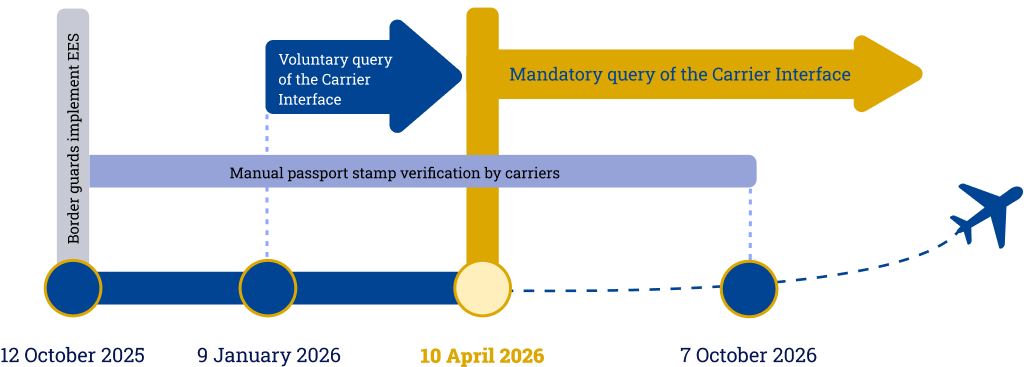
- 12 October 2025 —> Border guards start implementing EES.
- 9 January 2026 —> Voluntary query phase of the Carrier Interface.
- 10 April 2026 —> Mandatory query of the Carrier Interface begins.
- 7 October 2026 —> End of the transition period; EES fully implemented.
EES deadlines for air operators
Starting 10 April 2026, carriers will be legally required to query the Carrier Interface to verify travelers holding short-stay visas for one or two entries. Additionally, during the first six months, carriers must manually verify visa stamps in passports to determine the final Passenger (PAX) status for EES.
| Transition Period — How to Check Your Passengers for EES
(Manual) Passport Stamp Verification + (Manual OR Automated) EES Queries = Final EES PAX Status |
We recommend that air operators begin querying the system during the voluntary phase to ensure everything is functioning correctly. This proactive approach allows carriers to resolve any issues and clarify any questions before non-compliance consequences, such as fines, become enforceable.
Still looking for a solution to stay compliant? Discover the quickest way to get connected to EES.
eu-LISA and EES vlog: Frequently Asked Questions
Below you'll find some of the most common questions about EES answered in short video clips:
- What is eu-LISA?
- Is it my responsibility to track eu-LISA?
- How does EES work with Leon & PnrGo?
- Who does the EES apply to?
- Does EES apply to CREW members?
- How do these regulations apply to private flights?
- What possible statuses can PAX have under EES?
- What does an 'NA' response mean?
- What does a 'NOT OK' response mean?
- What does it mean to have a 'greenlighted' PAX—can I bring them?
- What are the penalties for non-compliance?
These materials have been prepared in collaboration with our integration partner, Leon Software. Leon users can benefit from automated EES queries directly within their flight management system (see: Video #3).
1. What is eu-LISA?
BACK TO: MINI VLOG CONTENTS
View transcript
To start with, what is eu-LISA all about?
eu-LISA is an EU agency taking care of IT systems, and they’re the ones responsible for the EES and ETIAS systems.
EES is the Entry/Exit System — this is the one that is coming quite soon.
ETIAS is the next step that will come later on.
2. Is it my responsibility to track eu-LISA?
BACK TO: MINI VLOG CONTENTS
View transcript
Is it my obligation to track it?
Well, it is absolutely the carrier’s obligation to vet passengers against eu-LISA systems.
In the first stage, the carrier needs to send passengers that have a single- or double-entry visa to eu-LISA to check if they have a valid visa.
3. How does EES work with Leon & PnrGo?
BACK TO: MINI VLOG CONTENTS
View transcript
Will the integration between Leon and PnrGo be ready from the start?
Absolutely. The whole integration and preparation for eu-LISA has already been made. The integration has been tested and everything is working correctly.
What advantages does the integration with Leon software provide?
If you are using Leon, you can basically forget about the whole vetting process — the whole thing is done automatically.
The data of flights, passengers, and crew are taken from Leon to PnrGo. Then PnrGo decides which of the passengers need to be vetted and on which flights.
After receiving the vetting statuses from eu-LISA, they’re directly input into the checklist in Leon, where you can see exactly which passenger received what status.
Additionally, in Leon, you can provide data like the type of visa or residence card, which will allow PnrGo to better decide which passengers need to be vetted. That way, you will get better answers.
4. Who does EES apply to?
BACK TO: MINI VLOG CONTENTS
View transcript
Who does EES apply to?
Okay, so there are two perspectives to answer this question.
The first one is from the passenger point of view: if you’re arriving to the Schengen Zone for a short-term visit, then you’re under the EES program. Your data will be collected and stored in the system.
But looking at it from the carrier perspective: carriers only need to vet the passengers that hold a single- or double-entry visa.
5. Does EES apply to CREW members?
BACK TO: MINI VLOG CONTENTS
View transcript
Does EES vetting apply to crew members?
So, the shortest and easiest answer here is yes. If they have a single- or double-entry visa, they need to be vetted against EES.
6. How does EES affect private flights?
BACK TO: MINI VLOG CONTENTS
View transcript
So now the question that has been asked at least a thousand times in the past two years:
How do these regulations apply to private flights?
Basically, the passengers and crew on private flights do not need to be vetted. But it doesn’t mean that the EES does not apply to them. It means that if a passenger comes to the Schengen Zone without a valid single- or double-entry visa or another required document, they will not be allowed to enter.
So they will have to go back to the other country.
7. What statuses can my PAX get from EES?
BACK TO: MINI VLOG CONTENTS
View transcript
So what possible statuses can a passenger get from eu-LISA?
In the first stage – when only EES is active – there are three possible answers.
First: OK EES — this means that a single- or double-entry visa was found in the system for this passenger and it’s still valid.
Second: Not applicable — this means that the passenger is not in the scope of EES. For example, they are EU nationals or visa-exempt.
Third: Not OK EES — this means that the single- or double-entry visa was not found in the system or it is no longer valid.
8. What does an 'NA' response mean?
BACK TO: MINI VLOG CONTENTS
View transcript
Passenger got a 'not applicable' response — what does it mean?
It means that this passenger is outside the scope of EES. So they can be nationals or citizens of European, Schengen, or other associated countries, or are, for example, visa-exempt.
What is really important to remember here is that there are some nationals who are theoretically visa-exempt, but only if they have a biometric passport. Those countries are the Balkans and Ukraine.
9. What does a 'NOT OK' response mean?
BACK TO: MINI VLOG CONTENTS
View transcript
PAX (passenger) received a 'Not OK EES' status — what can I do?
What is really important to remember is that even if your passenger receives a 'Not OK EES' status, it doesn’t mean that they cannot be brought to the Schengen Area. It means that you have to check if they have other documents that will allow them to come — for example, a residence card, a permit card, a long-term visa, or if they are holders of a diplomatic passport.
10. What does it mean to have a 'greenlighted' PAX—can I bring them?
BACK TO: MINI VLOG CONTENTS
View transcript
Okay, my passenger is already greenlighted. I’m sure of it.
Even if you receive 'Not OK EES', but you have checked all the other documents and can see that they do have another permission that allows them to come to the Schengen Area, then yes, you can bring this person to the member state.
But be extra, extra sure that they do have it; otherwise, the consequences can be quite dire.
11. What are the penalties for non-compliance?
BACK TO: MINI VLOG CONTENTS
View transcript
What are the penalties for not complying with these new regulations?
Each member state will decide penalties on their own, but some minimum penalties are already defined in the regulations.
For a single passenger, the minimum penalty is €3,000.
For the sum penalty for one flight, the minimum is €500,000.
eu-LISA and EES: Do you have any additional questions?
If any new questions arise, don’t worry—PnrGo is planning a free webinar in March 2026 with a live Q&A session. Follow us on LinkedIn to stay updated, or sign up for our newsletter to receive announcements.
What’s next: A quick overview of eu-LISA stages
We’ve just entered the first stage with the introduction of the Entry/Exit System (EES). But there are more programs coming to life in the future as part of the evolving eu-LISA framework.
Here’s a quick look at the upcoming stages:
- EES — Entry/Exit System (already in progress)
Applies to holders of single and double-entry visas. - ETIAS — European Travel Information and Authorisation System (in the last quarter of 2026)
Applies to visa-exempt travelers. - VIS — Visa Information System (TBD)
Applies to long-stay visas, residence permits, transit visas, and multiple-entry visas.
Choosing a well-prepared tech stack now can future-proof your business for the upcoming stages of eu-LISA.
PnrGo and Leon Software: Your tech stack for automated eu-LISA compliance
Let’s start with a simple introduction:
PnrGo |
Leon Software |
| PnrGo is a certified eu-LISA provider offering cloud-based solutions for business and charter carriers to handle EES, ETIAS, and VIS as well as traditional PNR and API transfers. | Leon Software is a specialized platform for flight scheduling, flight management, crew management, operations, maintenance scheduling and marketplace in business aviation — your day-to-day operational hub. |
PnrGo and Leon Software have teamed up to offer a comprehensive solution for automated EES compliance. By integrating PnrGo’s automated data compliance tools with Leon’s flight management platform, air carriers can seamlessly meet regulatory requirements with just a single point of data entry.
This integration ensures a smooth data flow: users create a flight in Leon, entering all required PAX and CREW details. Leon then passes this information to PnrGo, which automatically processes eu-LISA queries, ensuring full compliance with the European Entry/Exit System (EES). Furthermore, the solution is already prepared for the upcoming ETIAS and VIS rollouts as eu-LISA continues to evolve.
Together, Leon Software and PnrGo offer a simple answer to the new challenge of meeting EES and ETIAS requirements, enabling air operators to focus on what they do best — delivering a seamless flight experience to their customers.
If you are interested in combining PnrGo and Leon Software for your flight or ground operation teams, contact us to book a meeting with one of our sales representatives.