

Crossing into U.S. airspace means navigating complex TSA and CBP rules. A missed status check, expired signatory agreement, or incorrect airport office hours can delay your flight or lead to regulatory penalties. PnrGo helps General Aviation (GA) operators follow the U.S. compliance mandates. While our automation simplifies data reporting, understanding some key regulatory nuances helps ensure smooth dispatch.
Foreign dispatchers and flight ops teams often struggle with the complex rules of U.S. domestic and transatlantic flights. Part 1 of this article series explores these compliance challenges for General Aviation (GA) operators, covering private Part 91 flights and Part 135 / 129 (*) charters.
|
(*) Are you managing a larger commercial fleet, heavy charter, or scheduled air service under Part 121 or Part 129? Do you operate under Part 125? |
Why U.S. flight compliance confuses foreign GA operators
When flying to, from, within, or over the United States, American operational definitions do not have a simple 1:1 translation for "commercial" versus "private" designations elsewhere. A flight designated as private under European regulations may be classified as commercial upon arrival in the United States, and vice versa.
Your compliance obligations shift based on this classification as well as aircraft weight and flight routing:
- Commercial GA Operators (Part 135 / Part 129): USA-based commercial operators must submit passenger data under the TSA Secure Flight program. Foreign-based commercial charter operators are generally exempt from the TSA Secure Flight vetting unless operating aircraft with an MTOW exceeding 12,500 lbs. In addition, each operator must submit and maintain a Master Crew List (MCL), with any updates sent at least 24 hours prior to departure. Separately, the U.S. Customs and Border Protection (CBP) requires passenger and crew manifest submissions for all international border crossings, plus crew data whenever overflying U.S. airspace or making ‘domestic’ stops on an international itinerary (such as fuel stops, migration stops, or ferry legs).
- Private GA Operators (Part 91): Private flights operating strictly within the U.S. are not subject to TSA or CBP filings. However, crossing the U.S. border triggers mandatory CBP passenger and crew manifest submissions, while overflying U.S. airspace requires crew data transfers.
| Because U.S. regulatory requirements may be subject to interpretation and enforcement discretion, it is always advisable to confirm specific obligations directly with the TSA and CBP. |
5 real-world regulatory traps dispatchers must watch out for
The U.S. aviation authorities enforce strict procedural rules that require constant operational vigilance.
1. eAPIS vs. iAPI submission
CBP offers two primary passenger data submission frameworks: eAPIS (batch processing, which generates the confirmation number required to request Permission to Land) and iAPI (interactive processing, returning real-time passenger clearance statuses).
Dispatchers sometimes ask if they can combine both modes to receive live statuses and confirmation numbers simultaneously. Unfortunately, CBP prohibits such dual-mode submissions. To monitor individual passenger statuses (e.g. for ESTA or EVUS), operators must formally request that CBP enable an additional tab in the eAPIS portal for manual passenger status checks.
2. Local airport office hours conundrum
An obligatory Permission to Land is granted by local CBP officers at your arrival airport, not by a centralized automated system.
Consider the following scenario: You dispatch a flight to Hillsboro International Airport (KHIO) arriving on Thursday. The local CBP office hours run Thursday through Monday, 10:00–18:00 PT (closed Tuesday and Wednesday). If a standard 24-hour automated manifest submits on Wednesday, no local officers are on duty to process the request. For a Thursday arrival, your manifest must actually be submitted before the local office closes on Monday afternoon!
Operational diligence required: Software automates data transmission, but dispatchers must still exercise operational diligence. Dispatch teams should regularly consult official CBP General Aviation Airport Fact Sheets to check local office hours, landing clearance rules, and advance notification requirements for every destination airport.
3. The flight number suffix rejection
Flight operations teams frequently assign letter suffixes to flight numbers to handle operational delays or split legs (e.g., converting "LH400" to "LH400A"). However, neither CBP nor TSA systems accept flight numbers containing suffixes. Submitting a suffix causes immediate message rejection.
4. Visa Waiver Program (VWP)
A passenger holding an approved ESTA is not automatically cleared to board your aircraft. Under U.S. regulations, operators transporting ESTA passengers must hold an active Visa Waiver Program (VWP) Signatory Carrier Agreement with CBP.
These agreements expire periodically and require formal renewal. If your carrier agreement lapses, carrying ESTA passengers into the U.S. is illegal—regardless of whether individual passengers hold valid ESTA approvals.
5. Occasional clearance asymmetries
Flight legs between the U.S. mainland and U.S. territories may carry unexpected directional rules.
One such example is the U.S. Virgin Islands (USVI):
- Mainland U.S. to USVI: Typically processed outbound as a domestic flight leg.
- USVI to Mainland U.S.: Requires mandatory CBP clearance prior to departure.
Because return legs from the USVI require explicit CBP filings, dispatchers must ensure these mandatory actions are factored into their flight plans.
How PnrGo facilitates U.S. compliance for GA fleets
PnrGo was designed specifically around General Aviation operational realities, such as last-minute passenger swaps, sudden flight reschedules, and multi-regime data compliance.
Here are the advantages that resonate most strongly with our users:
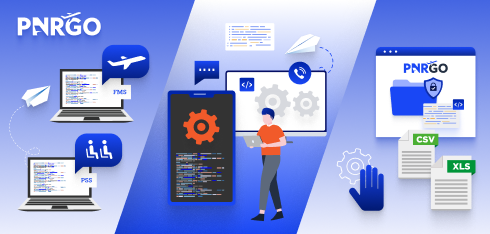
- Direct FMS integration: Passenger and crew manifest data and any MCL updates are pulled directly from your Flight Management System (FMS). Eliminating manual data re-entry reduces typo-driven errors and saves valuable dispatch time.
- Automated data harmonization: PnrGo takes care of details that can easily lead to syntax errors, including the removal of flight suffixes or ensuring proper message formatting. This helps maintain compliance while giving dispatchers greater peace of mind and reducing the pressure of getting every detail right.
- Automated TSA Secure Flight: PnrGo automatically submits Secure Flight Passenger Data (SFPD) — along with updates for any last-minute changes — within the required 72-hour window before departure, and syncs status responses back to your FMS.
- TSA testing exemption: Operators using PnrGo can declare our platform to the TSA to bypass lengthy testing cycles, significantly speeding up onboarding.
- eAPIS confirmation syncing: Following a CBP submission, PnrGo transfers the eAPIS confirmation number back to your FMS. This allows your dispatch team to promptly submit Permission to Land requests to local CBP officers (note: final landing permission approval timing remains subject to local airport office responses).
- Tailored submission workflows: When onboarding with PnrGo, you select the submission model that fits your modus operandi:
- Fully automated mode: Ideal for operators seeking automated manifest generation and schedule-based filing triggers.
- Semi-manual mode: Automatically pulls and structures FMS data, but leaves the final transmission to a single dispatcher click—giving you precise control over submission timing when navigating tricky local airport office hours.
- Scalable operational authorizations: You can manage all your operations using one system. Whether you currently operate under Part 91 or Part 135, PnrGo makes it possible to add new designations (such as Part 129 or Part 121) to your subscription as your fleet and service capabilities grow.
- Audit-ready records: Instantly download complete PDF archives of the submitted manifests, giving your team solid documentation for regulatory reviews.
Navigating U.S. flight regulations requires a combination of regulatory awareness and reliable software integration. By monitoring local CBP airport fact sheets and leveraging automated data pipelines, your flight ops team can eliminate compliance friction and maintain smooth operations within the U.S. jurisdiction.
Ready to simplify your U.S. dispatch workflow and eliminate manual reporting errors? Contact the PnrGo team today to learn more about our tailored U.S. flight compliance solutions.